Magical Thinking OCD: Signs, Symptoms, and Healing.
Disclaimer: This article is for educational purposes only and does not replace expert medical or mental health advice. Magical thinking in OCD requires a comprehensive psychiatric evaluation by a qualified clinician. So, always refer to a licensed mental health specialist for diagnosis and treatment.
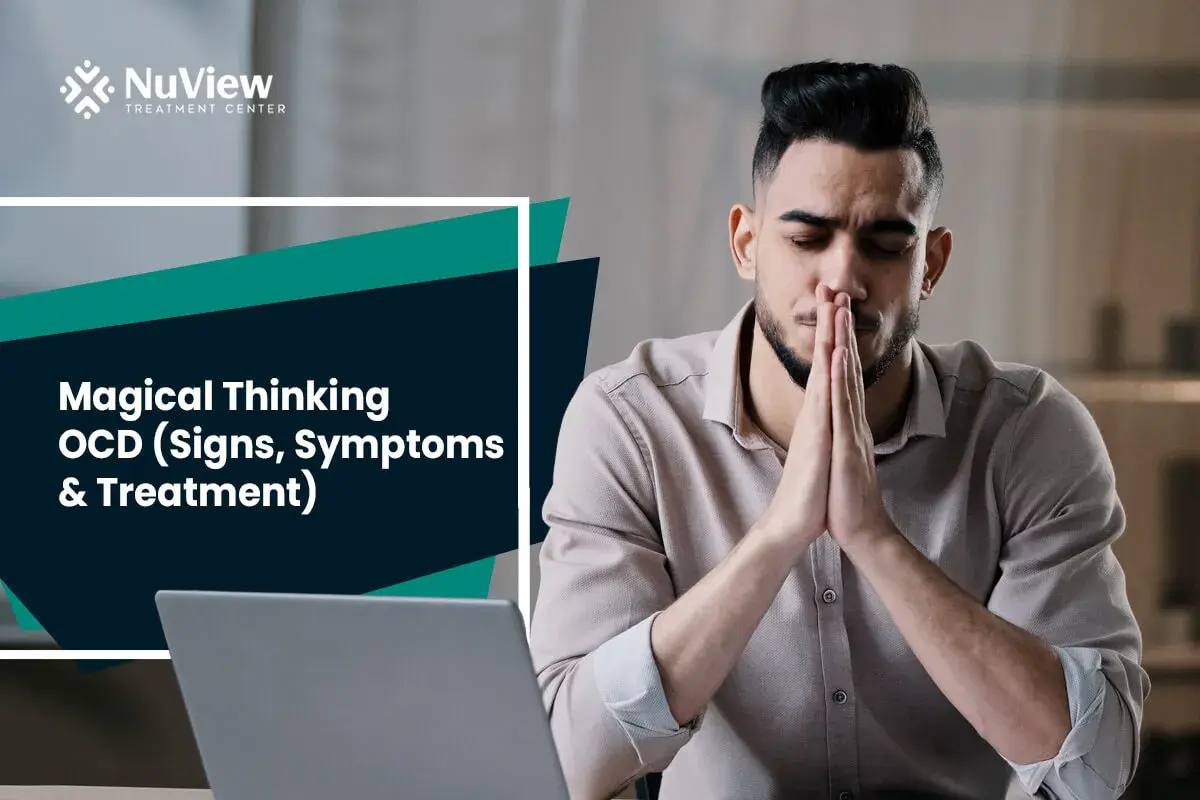
Magical thinking OCD is a subtype of obsessive-compulsive disorder that is characterized by intrusive beliefs or superstitions that your thoughts or behaviors are going to impact the world. These intrusive thoughts (obsessions) lead to compulsive behaviors to neutralize or suppress the obsessions. However, they only offer a temporary relief and reinforce the fears and anxieties. This is why reaching out to licensed and experienced mental health specialists is crucial for healing and a fulfilling life.
What Is Magical Thinking OCD?
Magical thinking OCD is a specific subtype of OCD that is characterized by a belief that your thoughts and behaviors are going to impact real-world consequences, even if there is no connection between them.
Superstitions are common. For instance, most of us may believe that saying something out loud may jinx it. Yet, magical thinking OCD is different in that it is too rigid and extreme, and it impedes your daily life and functioning. Such as - if you do not lock and re-lock your door ten times, someone might break in.
These obsessions and compulsions take up huge chunks of time in your daily life; they impact your mind, your relationships, and the experience of life itself.
Get Started With Nuview Treatment Center
Our dedicated professional staff is here to guide you or your loved one on the journey to lasting recovery, offering support every step of the way.

What Are the Risk Factors for Magical Thinking OCD?
There is no one risk factor that plays a role in the development of magical thinking OCD. Instead, experts have suggested a combination of risk factors, such as:
- Family studies have shown that having a close relative with OCD can make it twice as likely to develop magical thinking OCD.
- Genetic studies have revealed that chemical imbalances in the brain in dopamine, serotonin, and glutamate levels can contribute to magical thinking OCD. The gene SLC1A1 is being considered as an integral factor; however, it is not definitive.
- One systematic review of etiology and symptom severity has revealed that trauma can be a significant factor in magical thinking OCD. 70% said that they developed OCD symptoms after a traumatic incident, while 30% said that their OCD symptoms worsened after the incident.
- Gender differences reveal that women are more likely to struggle with OCD symptoms than men.
What Are the Signs and Symptoms of Magical Thinking OCD?
The signs and symptoms of magical thinking OCD are divided into obsessions and compulsions.
Common kinds of magical thinking obsessions are:
- Believing that something real and bad will happen because you think, feel, or do something totally unrelated to the consequence. For instance, if I think something blasphemous, I am going to hell. Or, if I do not lock and unlock my door ten times, someone will break in.
These kinds of obsessions lead to magical thinking compulsions, such as:
- Praying
- Checking and rechecking things
- Repeating thoughts, words, or actions for a specific number of times
- Moving the body in a specific way
- Arranging and rearranging items or objects until they feel just right
- Seeking constant validation from family and loved ones.
Apart from the above, magical thinking OCD gives rise to fears and anxieties. While the compulsive behaviors may seem like neutralizing or suppressing them at the outset, they only serve to reinforce them. It also adversely impacts your quality of life.
Get Started With Nuview Treatment Center
Can Magical Thinking OCD Be Treated?
Yes. Clinical reviews and insight have shown that magical thinking in OCD can be effectively treated with psychotherapy and medication.
Peer-reviewed studies have shown that the widely used psychotherapeutic modalities are cognitive behavioral therapy (CBT) and exposure and response prevention (ERP) therapy. CBT changes the underlying patterns of magical thinking OCD, while ERP safely exposes you to your anxieties and fears to develop healthier responses and coping mechanisms that can replace compulsive behaviors.
Medications are also prescribed to offer relief from the symptoms of magical thinking OCD. The International OCD Foundation says that selective serotonin reuptake inhibitors (SSRIs) are the first line of treatment; however, clinical trials have also shown that a tricyclic antidepressant called clomipramine can be effective.
Studies published in the National Library of Medicine (NLM) have revealed that alternative options like transcranial magnetic stimulation (TMS) and deep brain stimulation (DBS) can also be effective, especially for treatment-resistant ocd.
Long-term outcomes have shown that 32% - 74% of those with OCD show meaningful improvement over a period of time. This is why early diagnosis and intervention become the foundation for a healthier, fulfilling life.
If You Are Struggling With Magical Thinking OCD, Reach Out Today!
If you or a loved one is struggling with magical thinking OCD, we understand how this distressing cycle of obsessions and compulsions can take a toll on your mind, body, and relationships. But you do not have to do this on your own - reach out to the NuView Treatment Center today. We offer a full continuum of personalized outpatient care that tailors evidence-based treatment options to your symptoms, needs, and goals.
Please contact us at (323) 307-7997 - we see you, and we are investing in your healing.
Frequently Asked Questions About Magical Thinking OCD
How can magical thinking obsessions be reinforced by compulsions?
Compulsions can temporarily reduce anxiety, but reinforce the false belief that you are responsible for preventing something bad or tragic. This traps you in a cycle of fear and repetitive behaviors.
Can magical thinking OCD make someone feel responsible for events entirely outside their control?
Magical thinking OCD can create an intense, irrational sense of responsibility for preventing something bad or tragic, even when there is no logical connection.
Can stress make magical thinking OCD worse?
High stress levels can often intensify intrusive thoughts and the urge to engage in compulsive behaviors.
Do people with magical thinking OCD usually recognize their thoughts are irrational?
Many may have the insight that their fears are unrealistic, but the anxiety still feels very real and urgent.
Can magical thinking OCD exist alongside other mental health conditions?
Magical thinking OCD can commonly co-occur with anxiety disorders, mood disorders, or other OCD subtypes.
- What Is Magical Thinking OCD?
- What Are the Risk Factors for Magical Thinking OCD?
- What Are the Signs and Symptoms of Magical Thinking OCD?
- Can Magical Thinking OCD Be Treated?
- If You Are Struggling With Magical Thinking OCD, Reach Out Today!
- Frequently Asked Questions About Magical Thinking OCD
- What Is Magical Thinking OCD?
- What Are the Risk Factors for Magical Thinking OCD?
- What Are the Signs and Symptoms of Magical Thinking OCD?
- Can Magical Thinking OCD Be Treated?
- If You Are Struggling With Magical Thinking OCD, Reach Out Today!
- Frequently Asked Questions About Magical Thinking OCD
Get Help Today!


- https://adaa.org/learn-from-us/from-the-experts/blog-posts/consumer/role-magical-thinking-ocd
- https://pmc.ncbi.nlm.nih.gov/articles/PMC7082239/
- https://www.ncbi.nlm.nih.gov/books/NBK553162/
- https://www.sciencedirect.com/science/article/pii/S0010440X26000039?dgcid=rss_sd_all
- https://www.sciencedirect.com/science/article/pii/S0010440X22000219
- https://iocdf.org/ocd-treatment-guide/
- https://pmc.ncbi.nlm.nih.gov/articles/PMC11170287/
- https://iocdf.org/ocd-treatment-guide/medication/
- https://pubmed.ncbi.nlm.nih.gov/1883256/
- https://pmc.ncbi.nlm.nih.gov/articles/PMC7059162/
- https://pmc.ncbi.nlm.nih.gov/articles/PMC3932438/


Everyone is Welcome Here and We All Have Your Back
Your healing journey deserves a personalized approach. At NuView, we integrate expertise in behavioral therapy, mental health, and substance use treatment to create a customized recovery plan tailored to your unique needs.
Connect with our Admissions Specialists today.
Written By
Dr. Ryan Peterson, MD