Religious OCD: Signs, Symptoms, and Recovery Options.
Disclaimer: This article is for educational purposes only and does not replace expert medical or mental health advice. Religious OCD requires a comprehensive psychiatric evaluation by a qualified clinician. So, always refer to a licensed mental health specialist for diagnosis and treatment.
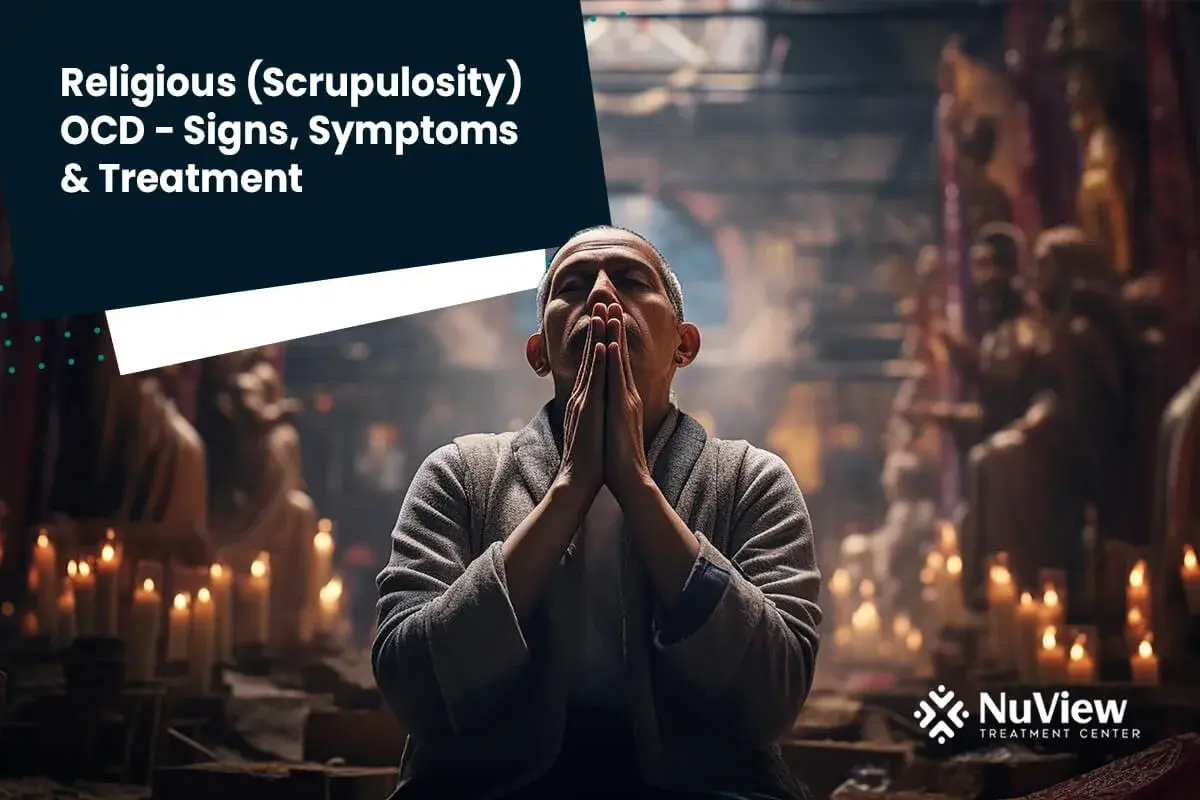
Religion plays a huge role in society and everyday life - it informs morality, way of life, and brings us together as a community. However, when faith turns into a repetitive cycle of fear and neutralizing behaviors, it may be an indication of religious obsessive-compulsive disorder (OCD), also known as scrupulosity. CNN reports that 5% to 33% of those with OCD report scrupulous thoughts and behaviors, with this number going as high as 50% to 60% in some countries.
While not everyone who is experiencing religious OCD is on the verge of a crisis - noticing these patterns early can enable you to seek the care you need and deserve without delay. Early interventions, in fact, lead to the best outcomes.
What Is Religious OCD?
Religious OCD is a subtype of obsessive-compulsive disorder that is characterized by obsessions (recurring, intrusive thoughts) and compulsions (repetitive behaviors or actions) pertaining to religion. For instance, out of the recurring fear of being punished by God or going to hell, you may perform repetitive rituals like praying or going to religious places of worship to neutralize these fears.
While compulsive actions bring temporary relief, they are not a cure. The cycle repeats again - taking away huge chunks of time from your day, impinging upon your life and relationships.
Dr. Ryan Peterson, a highly experienced physician at the NuView Treatment Center, says, “What differentiates religiosity from religious OCD is that the latter is a mental health condition where one fixates on religion - especially the fears surrounding it. This, in turn, leads to compulsive behaviors and rituals that are also religious, but unlike faith or belief, this cycle leads to significant distress and disturbance.”
Exploring What Care Could Look Like for You
If you want to explore what care options for religious OCD can look like for you, you do not need to have everything figured out at the beginning. You can simply speak with a mental health specialist what this looks like and see if outpatient care makes sense for you.

Get Started With Nuview Treatment Center
Our dedicated professional staff is here to guide you or your loved one on the journey to lasting recovery, offering support every step of the way.
What Are the Risk Factors for Religious OCD?
There is no one definitive risk factor, but a combination of factors that can play a role in the development of religious OCD. They are:
- Religion itself can contribute to religious OCD, as some peer-reviewed studies suggest that deeply religious persons are more likely to develop religious OCD.
- Family studies show that a family history of OCD can make it twice as likely to develop religious OCD.
- Genetic studies show that chemical imbalances in the brain, such as in dopamine, serotonin, and glutamate levels, can contribute to religious OCD.
- Trauma can be linked with religious OCD. One systematic review of the etiology of OCD reports that nearly 70% traced back their OCD onset to a traumatic event.
- Environmental factors, like an overemphasis on religion, can contribute to religious OCD.
What Are the Signs and Symptoms of Religious OCD?
The symptoms of religious OCD can be divided into obsessions and compulsions.
Common examples of obsessions are:
- Fear of being immoral
- Fear of sin
- Fear of death
- Fixation on purity
- Fear of being punished by God
- Fear of going to hell.
Common examples of compulsions are:
- Excessive praying
- Performing repetitive rituals
- Repeatedly reading sacred scriptures
- Repeatedly seeking reassurance and validation from religious leaders
- Self-sacrificing behaviors.
How Does Religious OCD Differ From Regular Religious Beliefs?
While religion can be related to religious OCD on a certain level, religious OCD has a tendency to disregard religion itself in several ways. For instance, where religion emphasizes faith in God over everything else, religious OCD will focus on compulsive behaviors like cleansing rituals to avoid being punished by God or going to hell.
Religious beliefs pertain to faith and peace of mind, and yes, while they are also related to fear and anxieties, they are not the whole and sole of it. Religious OCD is an unhealthy fixation on the fear and anxieties regarding religion and God.
Religion is meant to bring peace and community, but religious OCD leads to a pernicious cycle of fixation on religious doctrine and rituals, emotional distress, social isolation, and other kinds of dysfunction.
Get Started With Nuview Treatment Center
Can Religious OCD Be Treated?
Yes, religious OCD can be treated with psychotherapy and medication.
- Psychotherapy: The widely used therapeutic modalities for religious OCD and cognitive behavioral therapy and exposure and response prevention therapy. They focus on changing underlying patterns and fear responses so that you can reclaim control and lead a healthier life.
- Medication: Typically, selective serotonin reuptake inhibitors (SSRIs) are used to offer relief from OCD symptoms, but tricyclic antidepressants like clomipramine have also shown great promise. Medication decisions need to always be made in consultation with a board-certified physician or psychiatric practitioner.
- Alternative Treatments: If the first line of treatment for OCD is not effective, then alternative treatments like transcranial magnetic stimulation (TMS) and holistic practices like mindfulness can also be effective.
Dr. Peterson says, “Religious OCD can be mistaken for religiosity, which is why it is misunderstood and underreported. However, a significant portion of those who seek out recovery options report meaningful improvements and lead fulfilling lives. Early diagnosis and intervention lead to the best outcomes.”
Reach Out to NuView to Begin Healing Today!
Religious OCD can be misunderstood and challenging to deal with - but you are not on your own. Please contact NuView today - we provide a safe, non-judgmental setting, where you can relax, reset, and focus on overcoming scrupulosity toward a healthier, meaningful life.
If you want to explore structured care options, we offer outpatient options that allow you to receive care without stepping away from your life:
- Partial Hospitalization Programs (PHPs): PHP is a higher structured care option for more severe symptoms. It runs for 6 hours per day for 5 days per week, after which you can return home.
- Intensive Outpatient Programs (IOPs): IOP offers a more flexible level of care. It runs for 9-15 hours per week, which can be structured around your life. IOP can be the best for mild to moderate concerns, or if you are stepping down from higher levels of care.
Let Us Begin With a Conversation
If you are wondering what structured care can look for religious OCD - you can explore what your options look like in a safe, non-judgemental setting with experts who understand your experiences and offer clarity going forward.
Frequently Asked Questions About Religious OCD
What is religious OCD commonly known as?
Religious OCD is also commonly known as scrupulosity.
How is religious OCD different from religion?
Religious OCD is a mental health condition that leads to significant emotional distress and dysfunction, whereas religion is focused on beliefs of faith, peace, and harmony.
Is religious OCD more common among certain religions?
Religious OCD is not necessarily common in one religion more than the other, but deeply religious people are more likely to report religious OCD symptoms.
Does religious OCD go away on its own?
No, religious OCD does not go away on its own. While symptoms can vary in intensity, when left untreated, they can significantly worsen.
How long does it take to recover from religious OCD?
Some begin noticing improvements within a few weeks of consistent treatment, while for others, recovery may take several months or longer.
- What Is Religious OCD?
- What Are the Risk Factors for Religious OCD?
- What Are the Signs and Symptoms of Religious OCD?
- How Does Religious OCD Differ From Regular Religious Beliefs?
- Can Religious OCD Be Treated?
- Reach Out to NuView to Begin Healing Today!
- Frequently Asked Questions About Religious OCD
- What Is Religious OCD?
- What Are the Risk Factors for Religious OCD?
- What Are the Signs and Symptoms of Religious OCD?
- How Does Religious OCD Differ From Regular Religious Beliefs?
- Can Religious OCD Be Treated?
- Reach Out to NuView to Begin Healing Today!
- Frequently Asked Questions About Religious OCD
Get Help Today!
- https://edition.cnn.com/2014/05/31/health/ocd-scrupulosity-religion
- https://iocdf.org/faith-ocd/what-is-ocd-scrupulosity/
- https://www.mdpi.com/2077-0383/13/24/7575
- https://pmc.ncbi.nlm.nih.gov/articles/PMC7082239/
- https://www.ncbi.nlm.nih.gov/books/NBK553162/
- https://pmc.ncbi.nlm.nih.gov/articles/PMC12599354/
- https://www.sciencedirect.com/science/article/pii/S0010440X26000039?dgcid=rss_sd_all
- https://pmc.ncbi.nlm.nih.gov/articles/PMC4143776/
- https://iocdf.org/ocd-treatment-guide/medication/
- https://pubmed.ncbi.nlm.nih.gov/1883256/
- https://iocdf.org/about-ocd/treatment/tms/
- https://jamanetwork.com/journals/jamapsychiatry/fullarticle/204712


Everyone is Welcome Here and We All Have Your Back
Your healing journey deserves a personalized approach. At NuView, we integrate expertise in behavioral therapy, mental health, and substance use treatment to create a customized recovery plan tailored to your unique needs.
Connect with our Admissions Specialists today.
Written By
Dr. Ryan Peterson, MD