Perfectionism OCD: Signs, Symptoms, and Treatment Options
Disclaimer: This article is for educational purposes only and does not replace expert medical or mental health advice. OCD and perfectionism require a comprehensive psychiatric evaluation by a qualified clinician. So, always refer to a licensed mental health specialist for diagnosis and treatment.
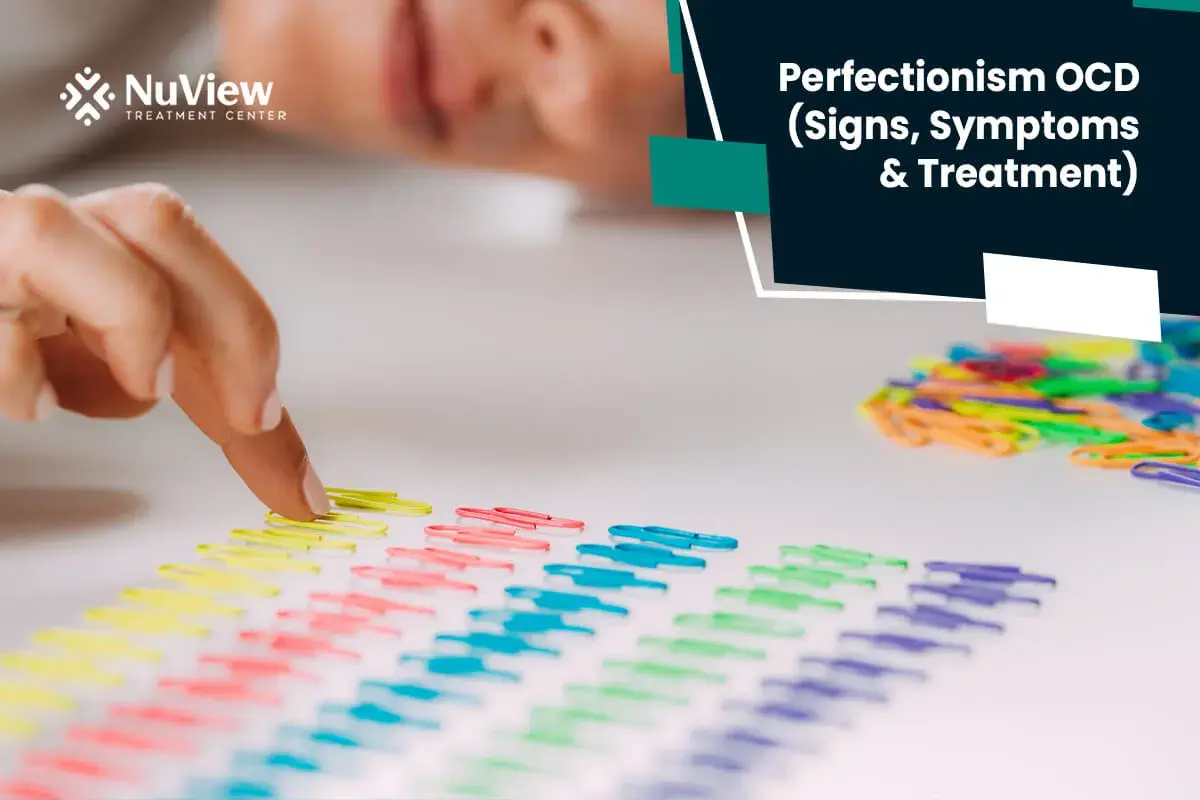
Perfectionism OCD is a subtype of obsessive-compulsive disorder that is characterized by obsessions and compulsions revolving around perfectionism. So, something like arranging and re-arranging things until they are just right or perfect can be an indication of this condition. It leads to significant distress and disruption in daily life, which is why it is classified as a mental health disorder. The encouraging news, here, is that it can be effectively treated and managed with psychotherapy and medication. In fact, a 2019 clinical review in The Lancet suggests that early diagnosis and interventions lead to the best outcomes.
What Is Perfectionism OCD?
Perfectionism OCD, or just right OCD, is characterized by recurring, intrusive thoughts (obsessions) regarding things being imperfect. It is not a formal diagnosis on its own, but a subtype or theme of OCD.
Perfectionism-related obsessions are then followed by compulsive behaviors like attempting to correct these imperfections until things are just right. While compulsions offer temporary relief, there is no break to this - as obsessions and compulsions repeat again, and again, and again.
Dr. Ryan Peterson, a highly experienced physician at the NuView Treatment Center, says, “Those with perfectionism OCD perform compulsive behaviors to relieve the discomfort and anxiety coming from the obsessive thoughts about things being incorrect or imperfect. However, this becomes a pernicious cycle leading to mental distress, and it also impedes your daily life and functioning. This is why seeking early intervention and care enables you to manage this disorder toward a healthier, fulfilling life.”
Get Started With Nuview Treatment Center
Our dedicated professional staff is here to guide you or your loved one on the journey to lasting recovery, offering support every step of the way.

What Are the Risk Factors for Perfectionism OCD?
There is no one risk factor that plays a role in the development of perfectionism OCD, but experts suggest a combination of risk factors, such as:
- Perfectionism as a trait can contribute to perfectionism OCD and other mental health conditions.
- Family studies have said that family history of OCD can make it twice as likely to develop perfectionism OCD.
- Biological factors, such as chemical imbalances in the brain in dopamine, serotonin, and glutamate levels, can contribute to perfectionism OCD.
- Trauma can contribute to the development of perfectionism OCD. A systematic review of etiology says that nearly 70% traced back the onset of their OCD to a traumatic event.
- Gender differences show that women are more likely to struggle with perfectionism OCD than men.
What Are the Signs and Symptoms of Perfectionism OCD?
The signs and symptoms of perfectionism OCD can be divided into obsessions and compulsions.
Common perfectionism obsessions are:
- Persistent discomfort regarding things being imperfect (like asymmetrical or uneven).
- The feeling that a task is not done correctly or is incomplete.
- The fear that something bad or tragic might happen if things are left imperfect.
Common perfectionism compulsions are:
- Repeating daily actions until they feel right.
- Repeatedly arranging or re-arranging things until they are right or perfect.
- Counting, rewriting, or redoing tasks until they feel right.
- Physical movement involves moving in a way that is right.
- Ruminating over past actions to ensure they were done in the right way.
How Does Perfectionism OCD Impact Daily Life?
While a certain level of perfectionism can become a drive or motivating factor to do well and achieve in life, living under the weight of perfectionism OCD becomes a struggle. It takes a toll on your daily life, health, and well-being.
Perfectionism OCD comes from unwanted, intrusive thoughts, doubts, and fears that give rise to anxiety. These obsessive images are followed by compulsions to check, redo, or fix things to quell this anxiety - which leads to endless hours of checking, redoing, and fixing every day.
Unfortunately, these compulsions only reinforce the anxiety instead of relieving it. As you become accustomed to the practice of performing these elaborate actions of checking, redoing, and fixing, you find yourself getting trapped in an endless cycle that takes a toll on you physically and mentally.
It takes away from your time, relationships, career, and the experience of life itself. This is why seeking the care you need and deserve is a strong step toward a lasting, positive change.
Get Started With Nuview Treatment Center
Can Perfectionism OCD Be Treated?
Yes. Clinical reviews and insight have shown that perfectionism OCD can be effectively treated with psychotherapy and medication.
The widely used psychotherapeutic modalities are cognitive behavioral therapy (CBT) and exposure and response prevention (ERP) therapy. CBT changes the maladaptive patterns underlying OCD, while ERP slowly exposes you to your anxieties and fears in safe and controlled conditions to teach you healthier responses and coping mechanisms.
Medications are also prescribed to offer relief from the symptoms of perfectionism OCD. Typically, selective serotonin reuptake inhibitors (SSRIs) are the first line of treatment; however, a tricyclic antidepressant called clomipramine has also shown promise.
Medication selection and planning is only done in close consultation with a board-certified physician or psychiatric practitioner.
Alternative treatments like transcranial magnetic stimulation (TMS) and deep brain stimulation (DBS) can also be effective.
Dr. Peterson says, “A significant portion of those who seek treatment for OCD experience meaningful improvement over a period of time. A proper diagnosis and early intervention are highly recommended for the best and sustained outcomes.”
How Can NuView Help With Perfectionism OCD?
Living with perfectionism OCD can seem like a pernicious cycle with no light at the end of the tunnel. But you do not have to feel this way. Reach out to NuView today - our licensed and trained mental health specialists offer personalized care options that meet you where you are so that you can heal and move toward a healthier, fulfilling tomorrow.
Please contact us at (323) 307-7997 to connect with our experts now!
Frequently Asked Questions About Perfectionism OCD
What is the difference between helpful perfectionism and unhelpful perfectionism?
Helpful perfectionism is driven by inner principles and flexibility, bringing motivation and satisfaction. Whereas unhelpful perfectionism is fear-driven, rigid, and defined by unreachable standards and harsh self-criticism, ultimately harming well-being.
What is the difference between perfectionism and perfectionism OCD?
Perfectionism is a trait that is driven by the drive to achieve high standards and be perfect, whereas perfectionism OCD is a mental health disorder that is driven by anxiety and fears of things not being right.
What is the difference between perfectionism OCD and obsessive-compulsive personality disorder?
Obsessive-Compulsive Personality Disorder (OCPD) is a personality disorder characterized by rigidity, perfectionism, and control. Unlike OCD, those with OCPD often consider their behaviors to be appropriate or necessary (ego-syntonic), whereas OCD symptoms are typically distressing and unwanted (ego-dystonic).
Is perfectionism OCD common?
Perfectionism is a common feature in OCD, and nearly half of those diagnosed with OCD exhibit perfectionistic tendencies.
Does perfectionism OCD reduce on its own?
OCD symptoms may fluctuate over time. However, without appropriate treatment, symptoms often persist and may worsen. Early intervention improves long-term outcomes.
- What Is Perfectionism OCD?
- What Are the Risk Factors for Perfectionism OCD?
- What Are the Signs and Symptoms of Perfectionism OCD?
- How Does Perfectionism OCD Impact Daily Life?
- Can Perfectionism OCD Be Treated?
- How Can NuView Help With Perfectionism OCD?
- Frequently Asked Questions About Perfectionism OCD
- What Is Perfectionism OCD?
- What Are the Risk Factors for Perfectionism OCD?
- What Are the Signs and Symptoms of Perfectionism OCD?
- How Does Perfectionism OCD Impact Daily Life?
- Can Perfectionism OCD Be Treated?
- How Can NuView Help With Perfectionism OCD?
- Frequently Asked Questions About Perfectionism OCD
Get Help Today!


- https://www.thelancet.com/journals/lanchi/article/PIIS2352-4642(19)30376-1/abstract
- https://www.sciencedirect.com/science/article/abs/pii/S000579670200044X
- https://www.tandfonline.com/doi/full/10.1080/16506073.2025.2461472#abstract
- https://pmc.ncbi.nlm.nih.gov/articles/PMC7082239/
- https://www.ncbi.nlm.nih.gov/books/NBK553162/
- https://pmc.ncbi.nlm.nih.gov/articles/PMC12599354/
- https://www.sciencedirect.com/science/article/pii/S0010440X26000039?dgcid=rss_sd_all
- https://pmc.ncbi.nlm.nih.gov/articles/PMC9136022/
- https://link.springer.com/chapter/10.1007/978-3-319-17139-5_7
- https://iocdf.org/ocd-treatment-guide/
- https://pmc.ncbi.nlm.nih.gov/articles/PMC11170287/
- https://iocdf.org/ocd-treatment-guide/medication/
- https://pmc.ncbi.nlm.nih.gov/articles/PMC7059162/
- https://pmc.ncbi.nlm.nih.gov/articles/PMC3932438/


Everyone is Welcome Here and We All Have Your Back
Your healing journey deserves a personalized approach. At NuView, we integrate expertise in behavioral therapy, mental health, and substance use treatment to create a customized recovery plan tailored to your unique needs.
Connect with our Admissions Specialists today.
Written By
Dr. Ryan Peterson, MD